Why Improve Efficiency in Food Packaging Lines?

Time:2026-10-03 Author:Madeline
0%

Food packaging efficiency is no longer only a production target. It directly affects food quality, material use, labor pressure, and customer trust. The FAO’s State of Food and Agriculture 2019 estimates that 14% of food is lost between harvest and retail. The UNEP Food Waste Index Report 2024 also estimates 1.05 billion tonnes of food were wasted in 2022. Packaging cannot solve every loss. However, unstable filling, weak seals, product damage, and repeated stoppages can increase avoidable waste.

This is why manufacturers increasingly ask how to improve efficiency in food packaging lines. The answer begins with measurable evidence, not broad promises. Track overall equipment effectiveness, unplanned downtime, changeover duration, reject rates, and giveaway weight. A ten-minute delay may seem minor. Across several shifts, it becomes expensive. Operators may also notice details that dashboards miss, such as film drifting during a roll change or sauce collecting around a sealing jaw.

Reports from PMMI, including its packaging automation research, consistently highlight labor availability, automation, and flexible equipment as major industry concerns. These pressures make reliable line design increasingly important. Practical improvements may include preventive maintenance, standardized work instructions, quick-change tooling, sensor calibration, and operator training. The best solution depends on the product, package format, sanitation schedule, and workforce.

Efficiency is not simply “faster.” Faster machines can create more defects. A realistic evaluation should compare output with safety, quality, energy consumption, and waste. No line is perfectly efficient. That uncomfortable fact encourages better measurement, careful trials, and continuous review rather than exaggerated claims.
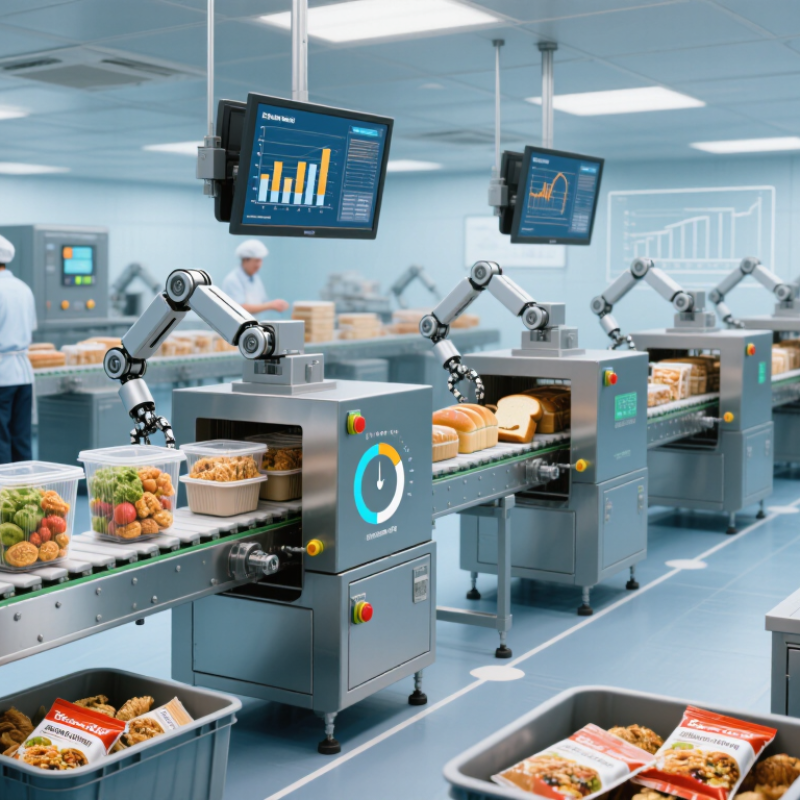
Why Improve Efficiency in Food Packaging Lines?

What Efficiency Means in Food Packaging Lines

Efficiency in food packaging lines means more than faster conveyors. It connects output, product protection, labor, energy, and reliable delivery. A line producing 120 packs per minute is not efficient if seals fail or rejects increase. Quality must move with speed. That balance matters.

During a packaging trial, I saw small delays reveal larger losses. A misaligned film roll stopped the line repeatedly. Each pause lasted less than a minute. Together, those pauses consumed nearly an hour. Operators also adjusted settings by feel, creating uneven seals. Clear work instructions, calibrated sensors, and routine checks reduced this uncertainty. Still, the result was not perfect. Changeover time remained longer than planned because cleaning steps were underestimated.

Practical efficiency starts with measurable details. Track good packs, rejects, downtime, changeover minutes, and energy use per batch. Compare planned speed with sustainable speed. The fastest setting may overload staff or damage packaging. Food safety controls must remain independent of production pressure. Traceable records help teams investigate recurring faults instead of guessing. Training also matters. An experienced operator may notice film tension before an alarm appears, but that knowledge should be documented and shared. Data can expose waste, yet people explain why it happens. People matter.

Key Factors That Influence Packaging Line Performance

Efficiency in food packaging lines is rarely decided by machine speed alone. Key factors include uptime, changeover control, material flow, quality checks, and operator decisions. On a real production floor, a fast filler can still lose hours beside a slow labeler. Small stops matter.

Vorne’s OEE Industry Standard uses 85% as a world-class reference. It combines availability, performance, and quality. However, 85% should not become a vanity target. A line running quickly with frequent seal defects may record impressive output and unacceptable waste. Engineers should separate changeovers, micro-stops, jams, and rejects in one dashboard. Data must explain losses. It should not decorate them. Sensors, barcode checks, and clear escalation routines can help, but they do not replace judgment.

People remain central. Deloitte’s 2024 Smart Manufacturing and Operations Survey found that 86% of manufacturing executives expect smart manufacturing to drive competitiveness within five years. That investment needs practical training, not only software. Operators need recipes, visual standards, and accessible troubleshooting guidance. Packaging materials also influence performance. A thinner film may reduce cost, yet create wrinkles or sealing variation. PMMI’s 2024 State of the Industry report highlights labor pressure, automation, and flexible equipment as major investment concerns. These pressures are real, but every line behaves differently. Our assumptions can be wrong. Improvement requires verified downtime records, disciplined maintenance, and honest review of yesterday’s decisions.

Operational Benefits of Improving Packaging Efficiency

Improving packaging efficiency changes the workday from constant recovery to controlled production. Operators spend less time waiting for materials, clearing minor jams, or repeating manual checks. On a busy line, even a five-minute delay can affect several downstream orders. Shorter changeovers also create more usable production time. That extra capacity can support seasonal demand without adding another full shift. Small gains compound. However, efficiency is not simply running equipment faster.

Effective teams begin by measuring actual performance, including cycle time, downtime, waste, and unplanned stops. Clear work instructions help operators respond consistently during ordinary pressure. Visual checks near filling, sealing, and labeling points can catch defects before they travel further. Preventive maintenance also reduces the familiar sound of a machine struggling. These practices support safer decisions and more predictable output. Yet measurements can mislead. A faster line is not efficient if damaged packs, rework, or customer complaints increase.

Efficiency improvements can also reduce material waste and unnecessary energy use. Better timing prevents film, cartons, and labels from being discarded during unstable starts. Training matters because a well-adjusted machine still depends on human judgment. In practice, not every adjustment works on the first attempt. Teams may need to test a slower speed, review the cause, and change the setup again. Recording those lessons builds reliable knowledge instead of relying on memory. A practical review should include operators, maintenance staff, and quality personnel, because each group sees a different part of the process.

Technologies and Methods for More Efficient Packaging

Efficient food packaging lines depend on practical technology, not speed alone. Sensors can track seal temperature, film tension, product weight, and conveyor timing in real time. When values drift, operators receive an alert before a small defect becomes a large batch of waste. Vision inspection also checks missing labels, weak seals, and damaged packs. These systems improve traceability when their data is reviewed carefully.

Changeover routines matter just as much. Digital work instructions can show the correct settings for each package size, while quick-release tools reduce adjustment time. Predictive maintenance uses vibration and temperature readings to identify worn bearings or unstable motors. However, automated warnings are not always correct. Our early trials showed false alarms during dusty production periods. Regular cleaning and human verification remained necessary.

Material efficiency requires controlled testing. Lightweight film may reduce waste, but it can also cause wrinkles, leaks, or slower machine speeds. Engineers should test seal strength, drop resistance, shelf-life performance, and line stability before approving a change. Operators provide valuable evidence because they notice jams that dashboards miss. Short training sessions, clear maintenance records, and documented quality checks support reliable results. One overlooked detail can still stop the line.

Why Improve Efficiency in Food Packaging Lines? - Technologies and Methods for More Efficient Packaging

Operational comparison of commonly used technologies and improvement methods

Technology or Method Primary Efficiency Target Typical Operational Improvement* Main Performance Indicators Practical Implementation Approach
Automated machine vision inspection Defect detection and product-quality consistency Quality inspection rates of approximately 60–300 products per minute, depending on package format and inspection points Defect detection rate, false-reject rate, customer complaints, rework percentage Inspect seals, labels, fill levels, codes, foreign objects, and package geometry before case packing.
Servo-driven motion control Machine speed, positioning accuracy, and repeatability Changeover and positioning adjustments can be reduced from manual multi-step settings to recipe-based settings; motion energy savings may reach approximately 10–30% in suitable applications Cycle time, positioning error, energy use per package, start-up scrap Use electronic cam profiles, stored recipes, and synchronized axes for filling, sealing, cutting, and labeling operations.
Predictive maintenance sensors Unplanned downtime and equipment reliability Condition-based maintenance programs commonly target a 10–20% reduction in downtime and a 5–15% increase in maintenance productivity Mean time between failures, mean time to repair, unplanned downtime, maintenance cost Monitor vibration, temperature, motor current, pressure, and air consumption; define alarm thresholds from baseline data.
Digital line monitoring and OEE tracking Visibility of availability, performance, and quality losses Real-time loss categorization can support an OEE improvement of approximately 5–15 percentage points when corrective actions are consistently implemented Overall equipment effectiveness, availability, performance rate, quality rate, micro-stoppages Connect machine signals to a dashboard and record downtime using standardized reason codes.
Quick-changeover procedures Product-format changeover time and startup losses Structured SMED-based projects often reduce changeover time by approximately 30–50% after internal and external tasks are separated Changeover duration, startup waste, first-pass yield, schedule adherence Pre-stage tools and materials, use visual settings, apply quick-release fixtures, and document standard work.
Lightweight and optimized packaging materials Material consumption, packaging waste, and transport load Material downgauging or right-sizing can reduce packaging material use by approximately 5–20% when product protection and legal requirements remain satisfied Grams of packaging per unit, material yield, damage rate, recycled-content percentage Optimize film thickness, tray dimensions, carton size, and pack density through controlled trials and transport testing.
Compressed-air leak management Utility consumption and pneumatic-system stability A systematic leak survey can reduce compressed-air losses by approximately 10–30% in systems with significant leakage Air consumption per package, compressor load, pressure stability, leak rate Use ultrasonic leak detection, repair priority lists, pressure regulators, and automatic shutdown during idle periods.
Heat-sealing process optimization Seal integrity, energy use, and packaging waste Controlled temperature, pressure, and dwell time can reduce seal-related rejects by approximately 20–50% where process variation is the main cause Seal-strength variation, reject rate, heater energy use, leak-test results Establish validated operating windows and verify seal quality through routine sampling and leak testing.
Standardized work and operator training Process consistency, labor productivity, and error prevention Clear standard operating procedures can reduce setup variation and operator-related errors by approximately 10–25% in repetitive packaging tasks Labor hours per unit, training time, setup errors, first-pass yield Use visual work instructions, skill matrices, checklists, and short interval control meetings.

*The improvement figures are indicative industry planning ranges rather than guarantees. Actual results depend on product format, equipment condition, line speed, material specifications, workforce capability, and baseline performance. Food safety, regulatory compliance, package integrity, and product protection should be validated before implementation.

Challenges in Measuring and Sustaining Line Efficiency

Why Improve Efficiency in Food Packaging Lines?

Challenges in Measuring and Sustaining Line Efficiency

Measuring food packaging efficiency is harder than counting finished cases. A line may produce 120 packs per minute, yet lose time through brief stops. These pauses often last less than one minute. Operators may clear a film wrinkle, reset a sensor, or replace a roll. The equipment restarts quickly. The lost capacity does not.

A practical efficiency review should separate availability, performance, and quality. Overall Equipment Effectiveness can reveal where losses occur. However, the result depends on accurate data. Manual entries may be late, inconsistent, or incomplete. A dashboard can look precise while hiding repeated micro-stops. That is uncomfortable, but important. Teams should compare system records with floor observations, shift notes, and quality checks. A five-minute observation may expose what a weekly report misses.

Sustaining improvement requires more than adjusting machine speed. Packaging materials, product temperature, cleaning schedules, and operator training can change daily results. Standard work should explain acceptable settings and clear escalation points. Short review meetings can examine one recurring loss, such as seal failures during product changes. Targets also need flexibility. An aggressive goal may encourage rushed checks and create more waste. The measurement process itself needs review. Is it helping people solve problems, or merely ranking shifts? That question is easy to overlook.

FAQS

What does efficiency mean in a food packaging line?

Efficiency balances output, product protection, labor, energy, and reliable delivery. Speed alone is not enough.

Why can a fast packaging line still perform poorly?

Failed seals, damaged film, and rising rejects reduce real output. A line making 120 packs per minute may still waste materials.

Which measurements help teams evaluate packaging efficiency?

Track good packs, rejects, downtime, changeover minutes, and energy use per batch. Compare planned speed with sustainable speed.

How do small delays affect daily production?

Repeated pauses can become major losses. Several delays under one minute once consumed nearly an hour.

What causes uneven seals during production?

Misaligned film, uncalibrated sensors, or manual adjustments can cause variation. Operators should follow clear settings and inspection routines.

How can changeovers become more efficient?

Record every cleaning and setup step. Underestimated cleaning time can extend changeovers. That mistake is easy to repeat.

Is an 85% efficiency score always a good result?

No. A high score may hide seal defects, jams, or excessive waste. The dashboard must explain losses, not decorate them.

What role do operators play in improving packaging lines?

Operators notice details before alarms, such as changing film tension. Their knowledge should become documented guidance, not personal guesswork.

Can thinner packaging material improve efficiency?

It may reduce material use and cost. However, it can create wrinkles or inconsistent seals. Testing should confirm the tradeoff.

Why are training and records important?

Training supports consistent decisions during faults and changeovers. Traceable records help teams investigate recurring problems instead of guessing. People matter.

Conclusion

Improving efficiency in food packaging lines means producing safe, consistent, and high-quality packages with less waste, downtime, labor, and energy. Efficiency depends on factors such as equipment reliability, line balance, material flow, changeover time, staff coordination, maintenance practices, and quality control. When these areas work together, packaging operations can increase output, reduce operating costs, improve product consistency, and respond more flexibly to changing production demands.

To understand how to improve efficiency in food packaging lines, companies should combine accurate performance measurement with practical process improvements. Automated monitoring, predictive maintenance, standardized work procedures, optimized layouts, employee training, and faster changeovers can all support better results. However, efficiency must be measured using clear and consistent indicators, including uptime, throughput, waste levels, and overall equipment effectiveness. Sustaining improvement also requires regular data reviews, strong communication, and a willingness to adjust processes as products, materials, and production goals change.

Madeline

Madeline

Madeline is a dedicated marketing professional with a wealth of expertise in our company's core offerings. With a keen understanding of the industry, she brings a unique perspective to her role, consistently delivering high-quality content that highlights the superior aspects of our products. As......